Tuesday, March 5, 2013

Government Teaching Programs

Teaching Assistant Program in France (aka TAPIF)- Work with young or high school age students in France and its overseas departments (French Guiana, Guadeloupe, Martinique, Reunion). The school year starts in October and ends in April. Must be intermediate French. Applications due: Early January
North American Language and Culture Assistants in Spain- Work in a K-12 setting in a public school in Spain. Posts are located across the country. School year begins in October and ends May 31st. Must have intermediate Spanish. Applications due: Early April
Teach and Learn with Georgia (TLG)- Work with students K-6 along side a co-teacher in rural Georgia. The school year begins in August until June. Applications due: Hiring will begin in June 2013.
English Opens Doors Program, Chile- Co-teach in public and semi-private schools for 6 months. Teacher are placed throughout Chile. Must have a degree from a university. Additional benefits include TEFL training, and an online Spanish course. Applications due: Year Round
Japan Exchange and Teaching (JET) Program- Applicants can apply for three different positions: Assistant Language Teacher (ALT), Coordinator for International Relations (CIR), or Sports Exchange Advisor (SEA). Participants are placed all over the country. Must be a citizen of a participating countryApplications due: Late November
English Program in Korea (EPIK)- Teachers will work in primary and secondary schools throughout Korea. Furnished apartments are provided. Contracts are for one year. Applications due: April for September placement and October for March placement

Wednesday, February 27, 2013

Kyrgyz Lagman Recipe

For the last cooking class, our teacher was going to help us make lagman (лагман) from scratch, noodles and all. Honestly, I had been waiting for this and fearing it all at the same time. Making homemade noodles is no joke, and as I quickly learned, perhaps more practice is necessary for me. I learned some more humility during this class. 
What is lagman? Lagman is this amazingly hearty stew with meat, vegetables, noodles (лапша) and a flavorful, spicy broth. Lagman is traditionally a Uyghur or Dungan dish. These Muslim minorities migrated from northern China to Kyrgyzstan and other parts of Central Asia. Now, lagman can been seen in Central Asia, China, and even Russia. 

So if you have a couple of hours and some friends to help, I totally recommend making some lagman.

Ingredients:
Noodles
8 cups of flour
1 1/2 cups of water water
2-3 eggs
Salt

Stew
1 lb of beef or lamb (we used beef)
3 cups of broth
1 onion
1 green radish
3 carrots
2 red bell peppers (In Kyrgyzstan, they are pickled with salt, but fresh is fine as well.)
1/4 cup of tomato paste
Head of garlic, minced
Vegetable or Sunflower seed oil
Chopped parsley for garnish


For the noodles
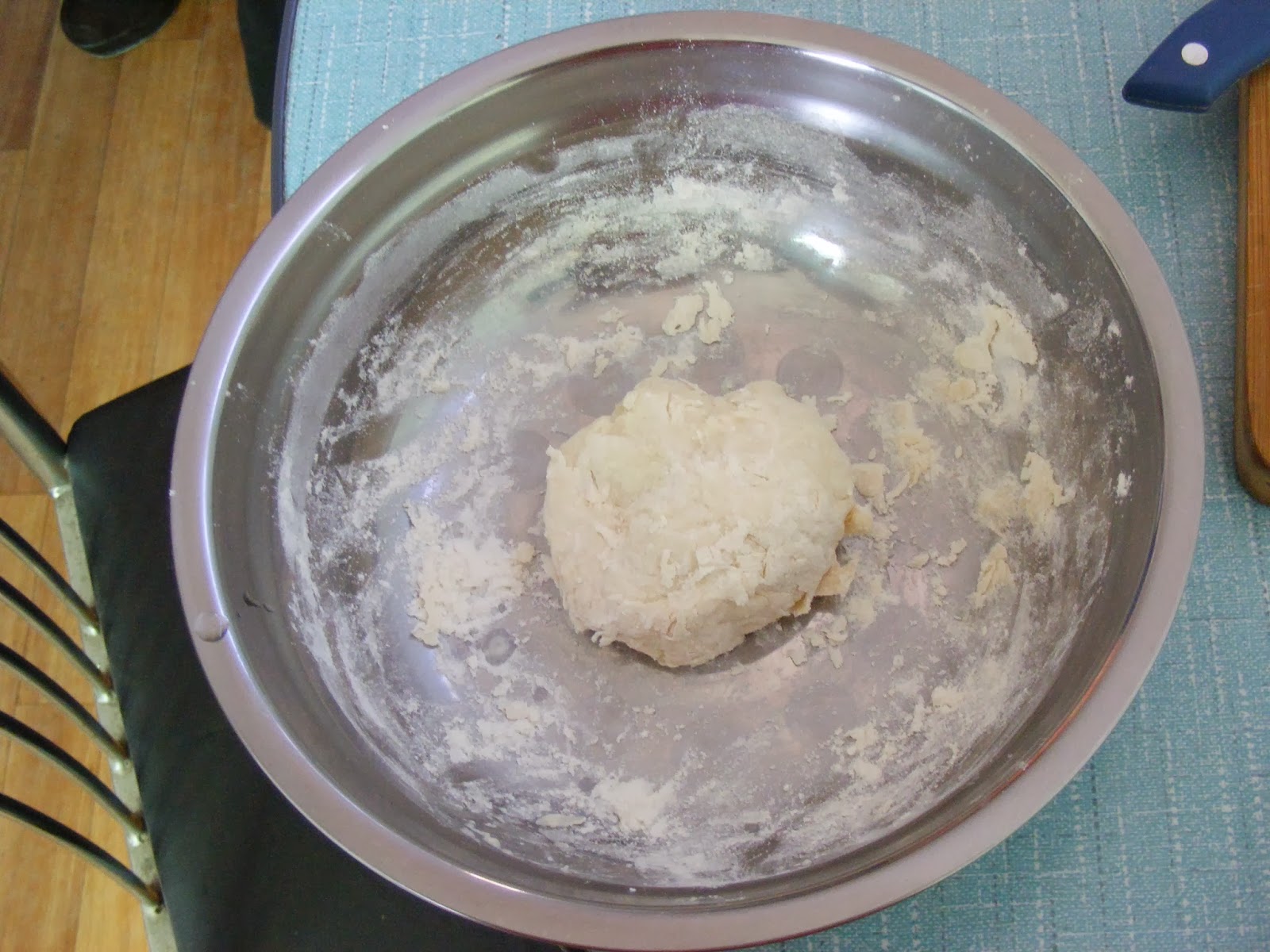
1. In a bowl, mix the flour, water and eggs together. 
2. Knead the dough until it is pliable (this will help later on). Then let it sit for 30 minutes or so.
3. Divide the dough into thick strands (see picture below). It is a good idea to oil your hands while working with the dough. Then cover the pieces in oil and let them rest for 10-15 minutes. 
4.  Begin to roll the dough with your palms against the table and stretch the dough. As the noodles get longer hit them against the table, it will help even out the dough. Don't for get to keep the noodles oiled as well.  If a strand is not stretching well, let it rest for a while.  (Don't worry if your noodles don't look nice! I questioned all my cooking abilities while doing this. I've been told it just takes practice)
5. Fold the noodles as they become longer and thinner.
6. In a pot of boil water, cook the noodles  for 5 minutes. Then rinse them in cold water and cover with oil. 
7. When serving, place the pasta first in your serving bowls. 


For the stew
1. In the meantime, slice onion (in "half moons"), carrots (matchstick), radish (matchstick), and meat (cubed).
2. First, heat up oil in a large pot. Add the meat, garlic, and onions. Cook until meat is slightly browned.
3.  Then add broth, carrots, radish, peppers, and tomato paste.
4. Let simmer for 10-15 minutes until carrots and radishes are cooked through.


For plating
Place the noodles in the bowl first, followed by the stew and parsley. If you like your lagman spicy, you can make a paste out of chili powder, red pepper, garlic, and oil to add on top. Enjoy!


Friday, February 22, 2013

Cafe Review: Sierra Coffee KG


Sierra Coffee KG
Manas, by the Russian Embassy

Snuggled in between two rather imposing buildings, Sierra Coffee offers customers comforting cups of Western coffee concoctions and familiar food. 

If you are looking for lattes, frappes, or a simple cup of coffee, you will not be disappointed purchasing it here. In addition to freshly ground coffee, the menu includes breakfast burritos, pancakes and waffles (with real maple syrup!), and a slew of sandwiches. 

There are many cafes in Bishkek, but in my opinion Sierra has the most relaxed atmosphere. As you walk in, you will see groups of dark wooden tables and chairs and sofas in a warm interior. Near the front window, there is a bar seating-area, which is perfect for people watching. To the left, there is a smoking room for smokers. There's a communal library near the sofas and Krygyz handicrafts line the other walls.  

Before going, I had read other reviews that the staff were not customer friendly; however, after visiting Sierra several times, I can say the rumors are not true. All of the staff speak Russian, Krygyz, and even English. In the short time that I have been here, I have become a regular, and the waiters and waitresses know my name and normal order, just like at any other Western cafe.   

The feeling of community does not end with the staff, most of the customers know each other at Sierra because this cafe is basically Bishkek's expat hub. You'll never know who you'll meet when you sit down. I've met people ranging from backpackers, embassy and IGO workers, young local professionals, local university students, to ESL teachers. If you are looking for any information about Bishkek or the surrounding area, stop here first. 

The only negative aspects that I have experienced so far are not enough seating (especially in the mornings on the weekend), prices are rather expensive in comparison to other places and sometimes the cafe is understaffed, but overall, Sierra has been an amazing source of comfort as I transition to life in Bishkek. 

Wednesday, February 13, 2013

Kyrgyz Plov Recipe


This week I started taking cooking. Our first lesson was Kyrgyz Plov.

Ingredients:
1lbs. 2 ounces beef (мясо)- cut into quarter size pieces
3 cups of rice (рис)- rinsed and sitting in water as you prepare the other ingredients (at least half an hour)
2-3 onions (лук)- cut in half and then cut into slivers (half-moons)
4 carrots (морковь)- julienned, about an inch long
1 1/5 cups of vegetable oil (масло)
1 head of garlic (чеснок)- peeled
1 bullion cube
1/2 cup of parsley (петрушка), chopped
Plov spice mix, red pepper, black pepper, and salt about 2-3 tablespoons of each

Directions
1. Prepare ingredients as stated in the ingredients list.
2. Pour vegetable oil in a large pot ( cast iron pot does well for this) over medium-high heat. Let oil get hot (you should hear crackling) and then place the onions in the pot.
3. When onions turn golden, add carrots on top of them. The place the шапка, or lid, on the pot for five minutes.
4. Add meat, salt, red pepper, black pepper, and plov spice (this is a mixture of cumin, garlic powder, coriander, carraway seeds, chili, paprika you buy in the store or markets here). Stir until meat looks brown.
5. Add water, enough to barely cover you ingredients in the pot. Add bullion cube. Let the bullion cube dissolve and take time to taste your sauce. This is the time to add anymore salt.
6. When the water has come to a boil, add your rice (that has been soaking in a separate bowl of water). Cover, and lower the heat so that the water simmers.
7. Preparing the garlic: take off the outer layers of garlic, leaving a bit of the skin on (see picture in previous post). When the water is gone, dig a little hole and bury the head of garlic. Cover and leave for 10 minutes.
8. Serve with chopped parsley, green onions and dill as garnish.


Wednesday, January 23, 2013

Arrival to Bishkek

It's day five since my arrival to Bishkek. Amazingly (for those of you who know the full story, it is truly amazing) I made it from GSO to LGA, a bus ride from LGA to JFK, JFK to IST, and IST to FRU.

There is a long hallway is IST lined with benches and outlets where captives of the airport sleep hunched over their bags and covered in puffy winter coats. After many cups of coffee and tediously trying to get some wifi signal, I decided to join them. Although not comfortable, I totally felt safe and not worried about my bags.


Early Saturday morning, I arrived in Bishkek. It wasn't the kind of magical winter wonderland that I remember in Estonia, but driving from the airport to the city watching the sun rise over the mountains and plans of snow was breathtaking. And that was my introduction to Kyrgyzstan.


I live in a flat near the school with other international students and the school cat, who I have affectionately named Luba (A Russian name I love but could never give a child.). My apartment is heated, includes an oven, a stove, a full-sized refrigerator, and an amazing shower. 


On Saturday, I had lunch at a cafe with a friend who introduced me to Central Asian cuisine. I was stunned at how flavorful it was compared to Eastern European and Caucasian food.


After lunch, I got lost. Like super lost, as in I am going to keep walking and hope to find a fire pit on the road to curl up next to, if necessary, tonight. I was looking for a grocery store, and kept getting distracted by these heinous circus posters everywhere. They were garish with a bear popping out of a swirling multi-colored background. This is how I missed my home. There was/is a wall covered in those posters right outside of my apartment that I had missed earlier. Having to look at the posters as I was walking home was just so shocking, I guess, I forgot to look for the blue building (my apt is sky blue). As I was walking along, a woman came up to me and started speaking Russian. I said I didn't know and that I was also looking for a building. A school. We walked together. She asked several people on the street if they knew where the school was. She even called some friends, but she had no luck. It wasn't until we were very far off that we met an English speaking piano student who decided to show me the way to a school (she didn't know if it was mine, but it was a school nonetheless).


While the girl and I were walking, I had my first fall on the ice. By the way, the sidewalks here are covered in at least an inch of ice. We were outside of a supermarket when my feet flew up in the air, I grabbed for a babushka, the old lady screamed, and I landed on my back. At that moment, I was so glad I owned a puffy jacket. My new friend asked if I was all right and the man beside the babushka kept imitating her scream in a falsetto. I wanted to say "No, I am not okay. I want to have a pity party and cry right now because I can't find my home and I just fell on my arse." But I did neither (although it was incredibly tempting), I smiled and moved on. Eventually, we did find my apartment before dark.


Now, some say my accident could have been avoided if I hadn't been wearing heels, but I insist that it is possible to walk in heels on the ice because the locals do it. I just have to find my ice feet.


The next day, Sunday, had so much potential, yet failed in so many ways. I had intentions of finding a cafe that serves American style cappuccinos and lattes, but my shower with the amazing water pressure flooded our bathroom. Unsure of what to do, I took a nap. Then I woke up, and the water had disappeared.

Unfortunately, the next day my shower did the same thing. As I was toweling off, I heard a knock on my door (mumbled something in English assuming it was one of my flat mates) and a tiny man's head appeared. Vie mae!! Startled, he shut the door. Shouting "one minute, one minute" in Russian, I quickly got dressed and asked why he was here. Apparently, my bathroom had flooded the first floor. As I tried to explain the doors of the shower were closed, and the water was "swimming" (I couldn't think of the proper Russian word) to the back of the wall of the bathroom and vanishing (this required miming), he splashed over to the pipes and said a proper technician would have to come. Two days later, we still don't know if the technician came. C'est la vie! 

Monday, September 10, 2012

The Challenges of Adapting


It has been almost a month since I arrived in Georgia, and two weeks since I arrived in the village.  I have been pondering this post for a couple of days, and I still haven’t come to a conclusion as to whether or not life in Georgia is becoming easier to navigate. 

The biggest challenge by far, especially living outside the major cities, is the language barrier. Initially, I assumed I could effortlessly live in Georgia with my knowledge of Russian and English; however, in my experience, this isn’t the case. First off, there is a group of people mid to early 20s that don’t know either English or Russian (these people would be considered potential friends and young taxi drivers). Additionally, for those who may know English, confidence issues and vocabulary limitations inhibit our ability to communicate. In regards to Russian, I have no more confidence issues, if something needs to be said I will try, but then again my vocabulary limitations hinder those conversations. All in all, I have come to the conclusion that it is necessary to learn Georgian. For some reason, I have really resisted, but sitting around the house and hanging out with my family’s friends with a blank stare on my face while everyone else is laughing or deep in thought is really quite depressing. 

The second issue is not sharing the common knowledge that everyone (aka all the Georgians) inherently understands. This problem is most prominent when it comes to transportation. Fares are hardly posted, except for a few marshutkas, and the prices change depending on the time of day. Of course, Georgians know how to navigate the seemingly unregulated transportation system, but it isn’t until you are shouting in English/Russian at a taxi driver about the fairness of their prices that you realize you might be missing something that everyone else knows. Another bit of common knowledge I seem to be missing is table etiquette. Apparently, one should always set the table for everyone, even if you are the only one eating. Also, I’ve noticed that all the food placed on the table isn’t meant to be eaten- the abundance is just meant for show and being able to resist eating all the food is a source of personal pride. Additionally, it is seen to be rude/odd if you just sip your wine when no one is toasting (but in my defense, the tamada takes way too long to toast especially if he is in a drunken stupor) and god forbid if your wine glass goes empty during a supra (which can be a fun/sad expat game to see how many times you can empty your glass before people realize). Clearly, the only answer to this problem is to make mistakes and ask questions. 

Finally, the physical adjustment of my body getting used to Georgian food and water has taken a long time.  Having been sick twice already, I would just like to be able to eat and drink without contemplating the health risks (which would be many by American standards) of my meals. On the other hand, I must admit my experiences at the medical clinics (in Tbilisi) have been really positive. 

Clearly, adapting just takes time and patience, but coming from a culture of instant gratification, I would really like to finish adapting to the culture right now.